
01PUWER 1998
Work equipment in use
PUWER places duties on those who own, operate or control work equipment. Regulation 11 sets a hierarchy for preventing access to dangerous parts, with fixed guards normally considered first.
Authoritative source ↗Hazard · access · response
Effective safeguarding connects the physical guard with safety distance, access frequency, stopping performance, interlocking, reset and the machine-specific risk assessment.
Request an engineering review ↗Take effective measures to prevent access to dangerous machinery parts or stop their movement before a person enters the danger zone.
Read the HSE overview ↗Practical compliance
A guard supplier can design and deliver an agreed safeguarding scope, but compliance depends on the complete machine, its intended use, controls, installation and ongoing management.
Oxford Machine Guarding defines the project boundary, required information, included checks and handover evidence. The responsible dutyholder should ensure the complete equipment remains suitable, maintained, inspected and used by trained people.
Commonly relevant framework
Applicability and the correct edition must be confirmed for the specific machine, project date and scope.
PUWER places duties on those who own, operate or control work equipment. Regulation 11 sets a hierarchy for preventing access to dangerous parts, with fixed guards normally considered first.
Authoritative source ↗General requirements for the design, construction and selection of guards used to protect people from mechanical hazards.
Authoritative source ↗Values for distances intended to prevent hazard zones being reached by upper and lower limbs. Aperture, height and distance must be assessed together.
Authoritative source ↗Principles for the design and selection of interlocking devices associated with guards, including measures to reduce defeat possibilities.
Authoritative source ↗General principles for the design and integration of safety-related parts of control systems where the guarding project includes safety functions.
Authoritative source ↗A general machinery-safety methodology for identifying hazards, estimating and evaluating risk, and applying risk-reduction measures.
Authoritative source ↗Guarding decision sequence
Identify dangerous movement, trapping, impact, ejection, heat, substances and stored energy.
Separate routine operation from setting, cleaning, fault recovery and maintenance tasks.
Use fixed separation where practical; introduce movable access only where the task requires it.
Define stopping, guard locking, stored-energy control, reset and restart prevention.
Agree the design review, functional checks, documentation and future inspection requirements.
Safety distance
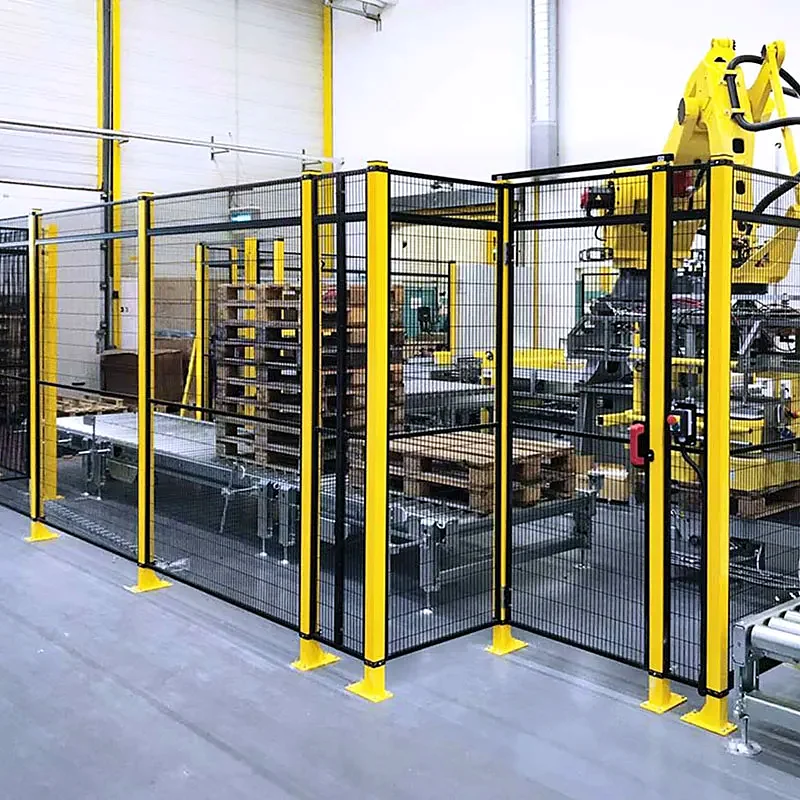
Aperture size, guard height, floor gap and the distance to the hazard determine whether someone can reach through, over, under or around the protective structure.
Product and conveyor openings need the same scrutiny. Tunnels, restricted apertures, distance, flaps, sensing or controlled transfer arrangements may be required around the flow.
Explore mesh machine guards →From finding to fix
Our retrofit pathway connects the machine survey, agreed PUWER guarding scope, detailed design, manufacture and installation.
This page provides general technical information, not legal advice or a machine-specific risk assessment. Standards and legislation may change. The responsible dutyholder should obtain competent, current advice for the actual equipment, use and modification.
Start with the machine and the task
Send photographs, dimensions or a short description of the machine. We will help define the survey, design and installation scope.
PUWER requires effective measures that prevent access to dangerous machinery parts or stop movement before a person can reach the danger. The correct guard, opening size, safety distance, interlock and restart logic depend on the machine-specific risk assessment.
A fixed guard is generally preferred where access is not needed during normal operation and removal can be restricted to an intentional maintenance task.
Interlocking may be appropriate where routine access is required and opening the guard must remove or control the hazardous condition before access.
Many machines can be retrofitted, but the assessment must include hazards, access, controls, stopping performance, interfaces and how the machine is actually used.