
Bespoke use of floor space
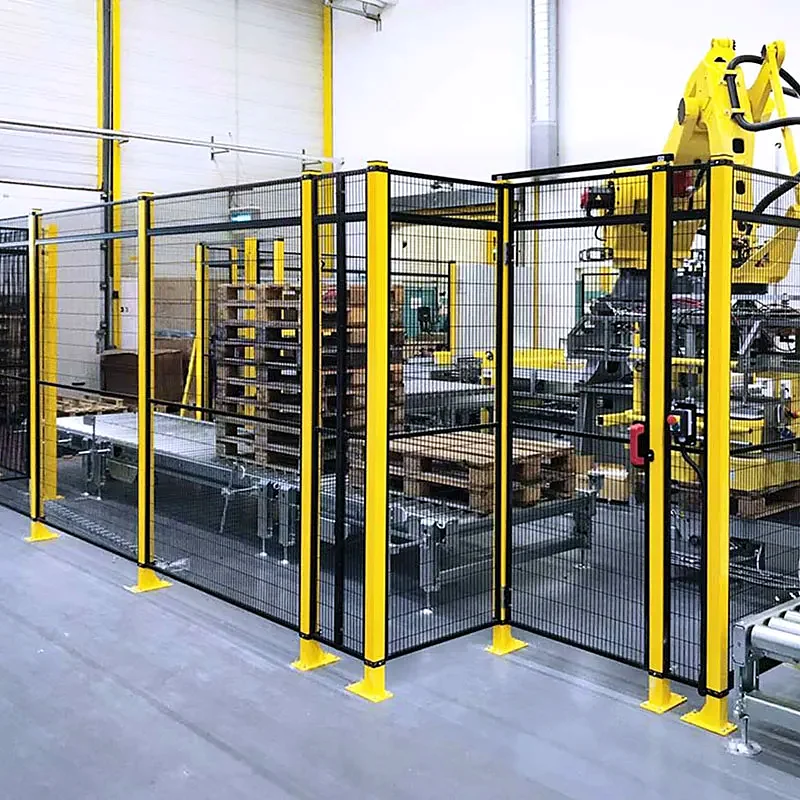
Posts, panels, corners and doors can follow restricted footprints and existing equipment instead of forcing the machine into a catalogue grid.
Perimeter guarding & safety fencing
Bespoke safety fencing and controlled-access guarding around automated machinery, robot cells and production areas where a standard kit cannot resolve the footprint or task.
 BMG / SOL
Direct answer
Perimeter machine guarding is a physical barrier positioned around a hazardous machine or automated area. It uses panels, posts and controlled access points to prevent people reaching dangerous movement while allowing the production, material-flow and maintenance tasks the cell requires.
The final safeguard must follow the machine-specific risk assessment, intended use and agreed modification scope.
Project outcomes
Physical construction, access and safety interfaces are developed together so the guard does not create avoidable operating or maintenance problems.
Posts, panels, corners and doors can follow restricted footprints and existing equipment instead of forcing the machine into a catalogue grid.
Welded mesh, transparent panels and solid infill can be positioned according to observation, airflow, ejection and reach-distance needs.
Hinged, sliding and removable sections can be coordinated with interlocks, locks and reset locations when the safety function requires them.
Design brief
These questions turn a broad guarding request into a machine-specific scope that can be reviewed, manufactured and installed.
Typical applications
Frequently asked
Concise project guidance for specifiers, engineers and dutyholders. The actual machine review determines the final approach.
Ask the engineering teamThe terms are often used interchangeably. In machinery applications, the important point is that the complete barrier—including panels, posts, openings and gates—is selected and positioned for the actual hazard and access tasks.
Height cannot be selected in isolation. The design must also consider distance from the hazard, the possibility of reaching over or under, mesh aperture, floor gaps and foreseeable climbing or access routes.
Yes. A project can combine modular panel sizes with purpose-made infill, frames, brackets and doors where the available footprint or equipment interfaces need a tailored solution.
Yes. The mechanical gate, switch mounting, guard locking and safety-control interface can be included in the agreed scope where required by the machine-specific risk review.
Start with the machine and the task
Send photographs, dimensions or a short description. We will help define the survey, design and installation scope.